
Knowledge that becomes capability inside your institution.
Twindix brings together research, diagnosis and institutional development, connecting people, roles, decisions and practices in a journey shaped around your business's needs.

Three pillars for understanding your institution.
We consider capabilities, the beliefs that shape decisions, and the practices that show up in everyday work.
Capabilities matched to the right role
Understand what a person can contribute and connect it to the role's requirements and the results the institution needs.
Beliefs that shape decisions
Identify the assumptions and beliefs that shape priorities and approaches to work and change.
Repeatable practices
Organise work into practices that can be applied, measured, documented and continuously improved.
Understand. Align. Build. Embed.
The tools support diagnosis and development; the scope of work depends on your project's needs.
Understand your reality
Diagnose roles, practices, capabilities and readiness so you know where to begin.
Executive Assessment · Job BarGo to assessmentsAlign the direction
Align your development and your team's development with the institution's goals and priorities.
EX-BOOST · EM-BOOSTDefine the business formula
Roles, authority, processes and knowledge that can be transferred and repeated.
In-Formula · People & HuntPut the model into digital practice
Test the right way of working, then support it with systems and automation.
DINFRA · PROTOPICS · GDIOutputs you can use in your work.
Depending on the diagnosis and agreed scope, the development journey can include the following outputs.
Gap and priority map
A clearer view of what needs attention and what you can build on.
Leadership development priorities
Practical priorities linked to the leader's capabilities and the demands of their role.
Operating model manual
Defined roles, authority, processes and target practices.
Measurement and review
Indicators and reviews that connect activity to outcomes and decisions.
Automation readiness map
What to design, test and digitize, and in which order.
Knowledge that stays with your team
Tools and understanding that your team can use and develop.
Understand your practices.
and choose your next development priority.
The Executive Assessment provides a starting point for understanding management practices, beliefs and capabilities. Interpretation of the results connects the report with your responsibilities and the reality of your organization.
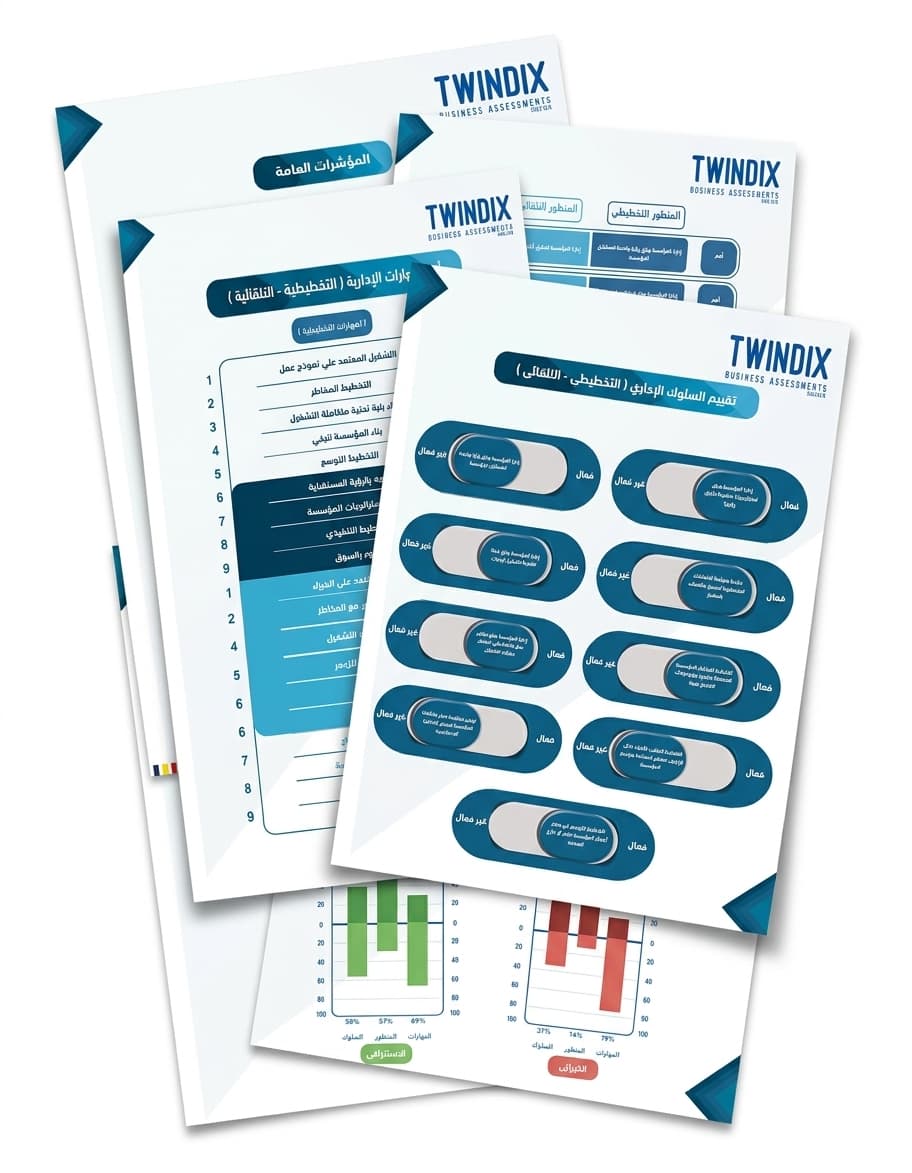
Original Arabic report sample
Where should
your business start?
You may need to test the market, clarify your role and your team's roles, understand cash flow or turn today's success into a repeatable model. We discuss the challenge in context before choosing an intervention.
What are you building, and which decision or problem are you facing now?
Understand the related roles, resources, processes and outcomes.
A clear priority, agreed outputs and a way of working that fits your needs.